
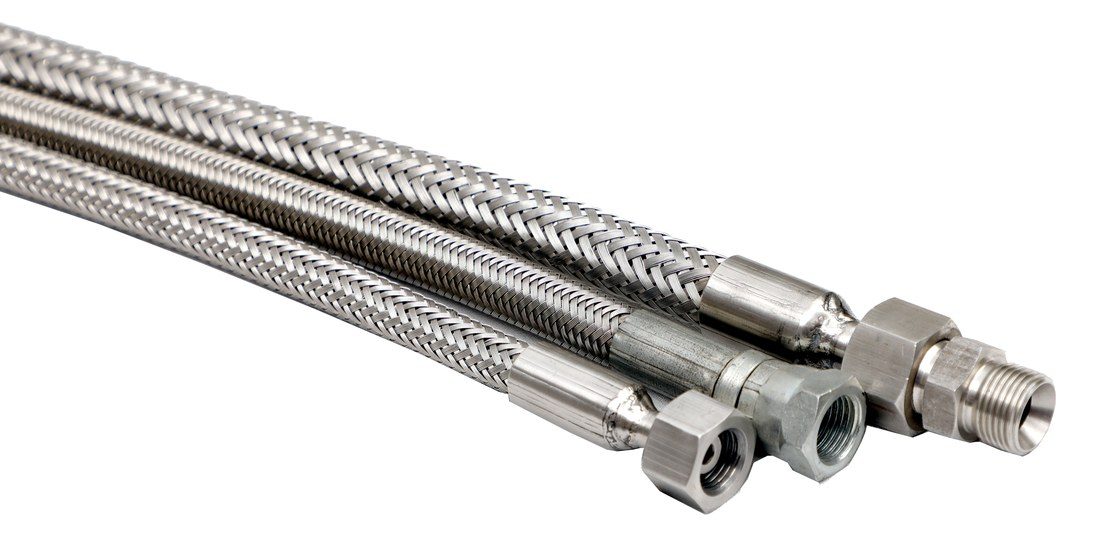
A braided corrugated hose assembly is a thin-wall stainless tube formed into annular corrugations, sheathed in wire braid and terminated with welded end fittings. It is pressure-tight, it flexes, it takes vibration out of a line, and it survives temperatures that put every non-metallic alternative out of the running. It is the highest-volume product we make.
How it is built, and why that matters

Annular, not helical

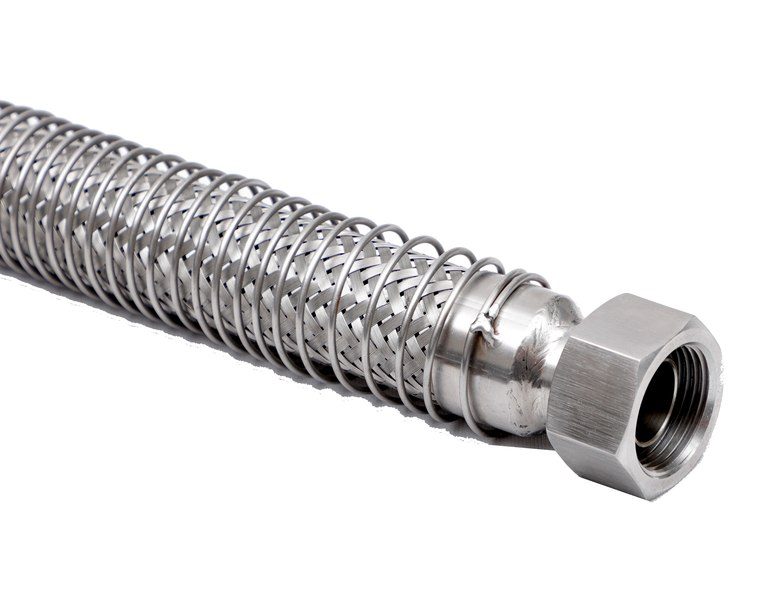
Our corrugated hose is annular — each corrugation is a complete ring at right angles to the hose axis, not a continuous screw thread. This is not a cosmetic distinction. A helical profile runs out at the hose end and disturbs the interface where the fitting is attached, and it generates a torsional load when the line is pressurised or takes a pressure shock. Annular corrugations give the fitting an undisturbed circular seat and produce no torsion under pressure. The scope of our ISO 9001 certificate names the product exactly that way.
The corrugation geometry trade-off


Profile height and pitch are the two levers, and they pull against each other. Raising the corrugation height and shortening the pitch buys flexibility and costs pressure resistance. Reducing wall thickness does the same. There is no profile that is simultaneously the most flexible and the strongest, so the profile is chosen against the duty rather than sold as a single "best".
| Corrugation profile | Wall | Pressure resistance | Flexibility | Typical use |
|---|---|---|---|---|
| Narrow / undercut | Standard | Lower | Highest | Tight-radius routing, frequent flexing |
| Standard pitch | Standard | Medium | High | General industrial — the default |
| Standard pitch | Increased | Highest | Moderate | High pressure, larger bore |
| Wide pitch | Standard | Medium | Moderate | Cost-sensitive, single-bend installations |
What the braid actually does


The braid is not armour. Its function is to stop the corrugated tube extending axially under internal pressure, and doing so raises the pressure capability of the hose by more than an order of magnitude. It works on a lazy-tongs principle — as the braid is pushed together its crossing angle and diameter increase, and as it is pulled the wires close up and lengthen. A braided assembly can also carry axial tensile load, which an unbraided hose cannot.
| Braid arrangement | Construction | Where we use it |
|---|---|---|
| Single braid | One layer over the hose | Standard duty across most of the range |
| Double braid | Two layers | Higher pressure at the same bore |
| Knurled braid | Wires within each carrier braided together | Larger nominal diameters, where wire cross-section per carrier must increase |
| No braid | Bare corrugated hose | Low pressure, vacuum, or where the hose is a conduit rather than a pressure part |


Working pressure and bend radius
This is the table most people come here for. Sizes run DN6 to DN350, and every column below — working pressure, hydrostatic test pressure, static radius and both flexing radii — comes straight from Essem's own technical data, not a derived or rounded figure. Pressures are in kg/cm² at
All 8 figures — Max WP and Test Pressure for each braid type, plus the three bend radii — are in the table below. If your screen is narrow, scroll the table sideways to see every column, including Test Pressure.
20 °C for a complete braided assembly with welded end fittings — apply the derating factors below for anything hotter.| Nominal Size | Without Braid | Single Braid | Double Braid | Min Bend Radius | ||||||
|---|---|---|---|---|---|---|---|---|---|---|
| Inch | mm | Max WP | Test Pressure | Max WP | Test Pressure | Max WP | Test Pressure | Static | Flexing Type-1 | Flexing Type-2 |
| 1/4 | 6 | 4 | 6 | 100 | 150 | 160 | 240 | 25 | 110 | 140 |
| 5/16 | 8 | 4 | 6 | 100 | 150 | 160 | 240 | 32 | 130 | 165 |
| 3/8 | 10 | 4 | 6 | 90 | 135 | 144 | 216 | 38 | 150 | 190 |
| 1/2 | 12 | 3 | 4.5 | 80 | 120 | 128 | 192 | 45 | 165 | 210 |
| 5/8 | 16 | 3 | 4.5 | 70 | 105 | 112 | 168 | 58 | 195 | 250 |
| 3/4 | 20 | 2 | 3 | 64 | 96 | 102 | 153 | 70 | 225 | 285 |
| 1 | 25 | 2 | 3 | 50 | 75 | 80 | 120 | 85 | 260 | 325 |
| 1 1/4 | 32 | 1.5 | 2.3 | 40 | 60 | 64 | 96 | 105 | 300 | 380 |
| 1 1/2 | 40 | 1.5 | 2.3 | 30 | 45 | 48 | 72 | 130 | 340 | 430 |
| 2 | 50 | 1 | 1.5 | 28 | 42 | 44 | 66 | 160 | 390 | 490 |
| 2 1/2 | 65 | 1 | 1.5 | 24 | 36 | 38 | 57 | 200 | 460 | 580 |
| 3 | 80 | 1 | 1.5 | 18 | 27 | 28 | 42 | 240 | 600 | 800 |
| 4 | 100 | 0.8 | 1.2 | 16 | 24 | 26 | 39 | 290 | 750 | 1000 |
| 5 | 125 | 0.6 | 0.9 | 12 | 18 | 20 | 30 | 350 | 1000 | 1250 |
| 6 | 150 | 0.6 | 0.9 | 10 | 15 | 16 | 24 | 400 | 1250 | 1550 |
| 8 | 200 | 0.5 | 0.75 | 8 | 12 | 12 | 18 | 520 | 1600 | 2000 |
| 10 | 250 | 0.25 | 0.36 | 6 | 9 | 9 | 14 | 620 | 2000 | 2500 |
| 12 | 300 | 0.2 | 0.3 | 4 | 6 | 6 | 9 | 720 | 2400 | 3000 |
| 14 * | 350 | 0.1 | 0.15 | 2 | 3 | 4 | 6 | 900 | 3000 | 3600 |
Four things to read alongside that table
Unbraided hose is not a low-cost braided hose. We supply it as bulk hose for customers who fabricate their own assemblies, and for low-pressure drain and vent duty. It is limited by convolution squirm. Never run it at braided-assembly pressures. If you fabricate your own ends, the attachment, the testing and the rating are yours.
Static and flexing bend radius are different columns for a reason. Static is a permanently formed installation bend. The two flexing columns, Type-1 and Type-2, are both for repeated movement — tell us the cycles and the amplitude your duty needs and we will confirm which one applies; Type-2 is the figure to use if you cannot get that information from us before you have to design the routing. Type-2 runs from about three times the static figure at the large end to five and a half times at the small end. Use the flexing figure whenever the hose moves, and read the number rather than applying a ratio.
For pulsating or surge service, halve the working pressure.
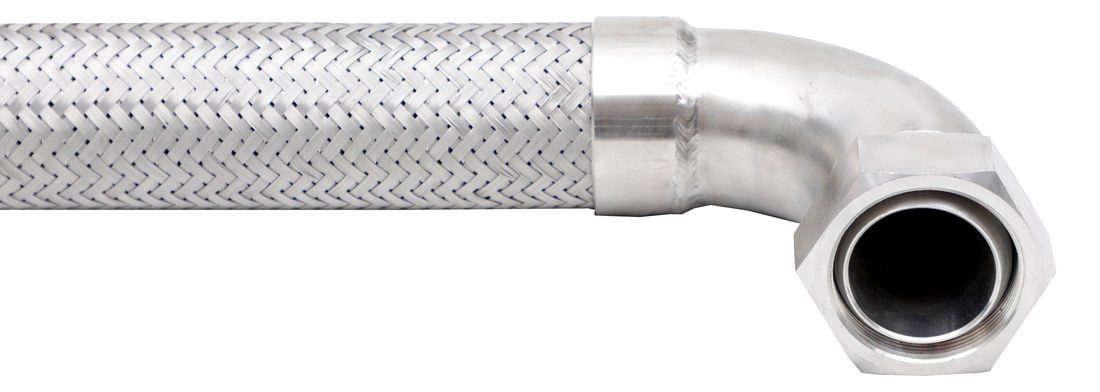
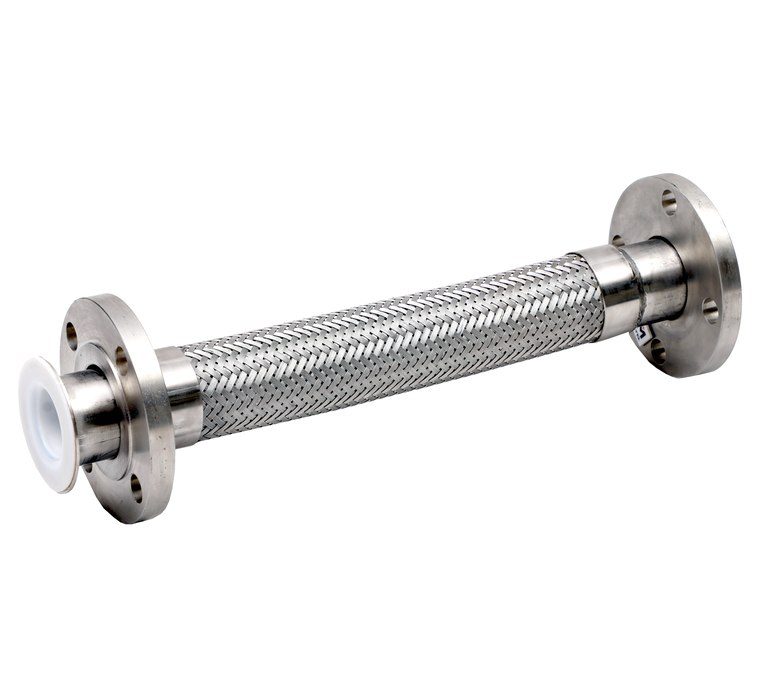
The fitting can limit the assembly. Fitting type, material and attachment method all cap the rating at temperature, sometimes below the hose itself.
The pressure basis we publish to
Two ratios govern every pressure figure on this site, and we hold both:
- Burst pressure is at least four times working pressure. A safety factor of four is the accepted basis for corrugated metal hose and it is what ISO 10380 assumes.
- Test pressure is 1.5 times working pressure. Every pressure-retaining assembly is hydrostatically tested before despatch.
- Every published rating is an ambient-temperature figure, taken at 20 to 23 °C. Hot lines take the derating factor from the table below; it is not optional and it is not small.
Temperature
Standard service for the stocked grades is −196 °C to +450 °C. Between 450 and 550 °C we derate and review the application with you. Above 550 °C the answer is SS 321 or Alloy 625 (UNS N06625), built to order.
| Medium temperature | SS 304L | SS 316L | SS 321 (to order) | SS 904L (to order) |
|---|---|---|---|---|
| 20 °C | 1.00 | 1.00 | 1.00 | 1.00 |
| 100 °C | 0.72 | 0.74 | 0.83 | 0.87 |
| 200 °C | 0.59 | 0.62 | 0.74 | 0.76 |
| 300 °C | 0.51 | 0.54 | 0.67 | 0.65 |
| 400 °C | 0.46 | 0.50 | 0.62 | 0.57 |
| 450 °C | 0.45 | 0.48 | 0.61 | — |
| 500 °C | 0.44 | 0.47 | 0.60 | — |
| 550 °C | 0.43 | 0.47 | 0.59 | — |
Bend radius — three numbers, not one

A single "minimum bend radius" figure is close to meaningless unless the duty is stated with it. We publish three, because they describe different things.
- Static bend radius — a permanently formed installation bend, made once and left alone.
- Dynamic (flexing) bend radius, Type-1 and Type-2 — the radius to design to where the hose flexes in service. Both are for repeated movement; which one your duty needs depends on the cycles and amplitude, so tell us and we will confirm it. Type-2, the larger of the two, runs roughly 2.9 to 5.6 times the static figure across our range, depending on size.
Installing to the static radius and then flexing the hose is one of the most common causes of premature failure we are asked to investigate. Bend radius and live length sets out the calculation.
Materials
The hose wall is formed from cold-rolled strip, welded longitudinally and then corrugated, so the material has to take a great deal of cold work without cracking. That requirement rules a lot of alloys out and is why austenitic stainless dominates.
| Component | Standard material | Alternatives on request |
|---|---|---|
| Corrugated hose | SS 316L (1.4404) | SS 304L (1.4307), SS 321 (1.4541), 904L, Alloy 625 (UNS N06625), Alloy 825 (UNS N08825) |
| Wire braid | SS 304 (1.4301) | SS 316L where the braid is exposed to the same medium or atmosphere as the bore |
| End fittings | SS 304 / SS 316L | Carbon steel, duplex, or to customer specification |
Full composition and cross-standard designations are on material grades.
What we need from you to quote
Seven pieces of information turn an enquiry into a specified assembly. They are set out in full, with the reasoning behind each, in how to specify an assembly.
Bore sizeTemperature — medium and ambientApplication and movementMedium and concentrationWorking pressureEnd connectionsDynamics — flexing frequency and amplitude