
The hose rarely fails first. The fitting, the weld and the braid termination are where most assemblies give trouble, which is why we treat the end connection as an engineering decision rather than a catalogue line.
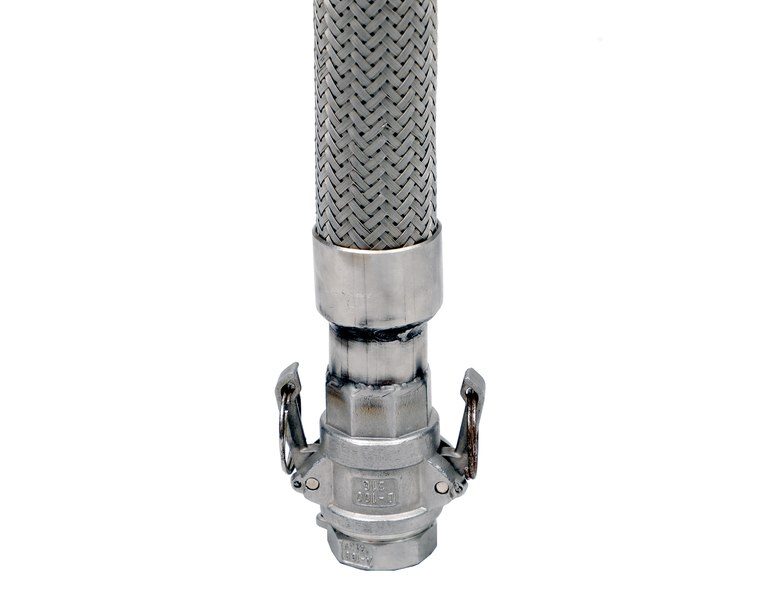
What we supply
| Family | Types | Standards |
|---|---|---|
| Threaded | Male and female BSP, BSPT, NPT | BS 2779, BS 21, ANSI B1.20.1 |
| Flanged | Fixed, floating and swivel; plate and weld-neck | DIN PN6–PN40; ANSI 150#, 300#, 600# |
| Hygienic | Tri-clamp (also called tri-clover), SMS nut and nipple, DIN union | Clamp to ISO 2852 / DIN 32676; DIN 11851 union; ISO 2037 tube; 3-A dimensional practice |
| Quick release | Camlock male and female, dry-break couplings | MIL-C-27487 Type A–F |
| Hydraulic | JIC 37° flare, ORFS o-ring face seal | SAE J514, SAE J1453 |
| Weld ends | Plain pipe end, socket weld, butt weld, concentric reducer, 45° and 90° elbow | ASME B16.11 |

How the braid is anchored
The braid carries the pressure thrust, so it has to be terminated as carefully as the hose. Braid wires are gathered under a collar and welded together with the hose and the fitting. That collar does two jobs: it contains the wires, and it immobilises the corrugations that the weld heat has affected. It is also, inevitably, a stress concentration — which is why bend restriction at the fitting matters so much and why we offer it as standard on dynamic assemblies.
Attachment method
| Method | Where used | Note |
|---|---|---|
| TIG / GTAW fusion welding | Standard for stainless assemblies | Full penetration, argon-shielded, welder-qualified |
| Brazing | Selected small-bore and dissimilar-metal joints | Lower heat input |
| Mechanical swaging | Interlock hose ferrules | Restrains the helix as well as sealing |

Getting the length right
Overall length is measured face to face, or sealing surface to sealing surface, including the fittings. The live length — the flexible portion between the fitting terminations — is what actually does the moving, and it is the number that governs bend radius and movement capability. When you specify a length, tell us which one you mean. See bend radius and live length.