
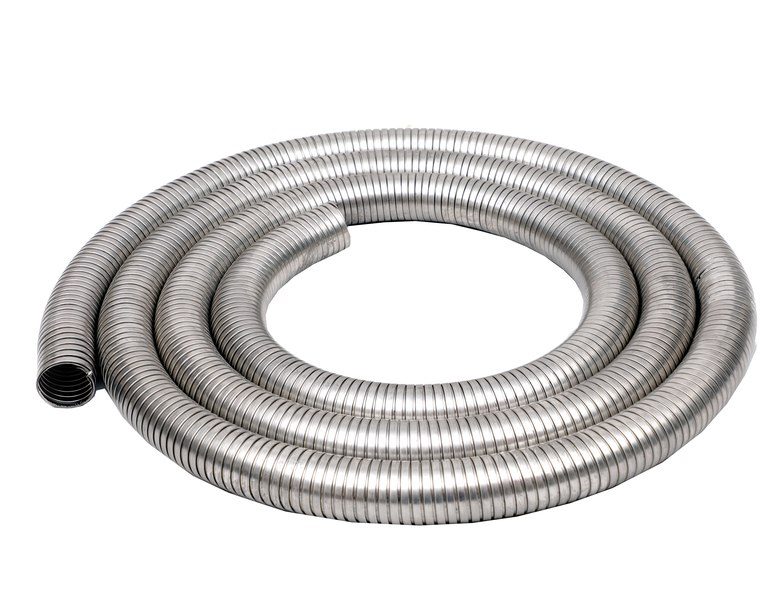
Interlock hose is made from a single profiled stainless strip, wound helically so that each coil locks into the one before it. It is not a pressure vessel and it is not sold as one. What it is exceptionally good at is surviving heat, resisting abrasion, damping vibration and protecting whatever runs inside it.
Where the flexibility comes from

A corrugated hose bends because its corrugation flanks stretch and compress elastically. An interlock hose bends because its coils slide against one another. That mechanical action is also why interlock damps vibration so well — the friction between coils dissipates energy rather than storing and returning it. It is the same property that makes interlock the standard choice for engine and generator exhaust connections.
The three construction types
| Type | How it is built | What it is for |
|---|---|---|
| Double interlock | Overlapping strip sections give good axial strength with full bending flexibility | The most common type. Our default for protective sleeving and general conduit |
| Loose interlock (squarelock) | Minimal strip engagement for maximum bending flexibility | Tight or irregular routing where axial load is low |
| Polygonal interlock | Polygonal cross-section giving torsional rigidity without losing lateral flexibility | Where the hose must resist twisting but still bend freely |
Torsion is what kills interlock hose
More of them fail from twisting than from anything else, and the resistance to twisting comes from the shape of the cross-section rather than the strength of the lock. That is what the polygonal type is for. Two rules follow: never use an interlock hose to take up misalignment by twisting it, and never cut one without fixing the cut end straight away — an unrestrained helix unwinds.

Sizes
| DN | Bore (mm) | OD (mm) | Static bend radius (mm) |
|---|---|---|---|
| DN6 | 6 | 8 | 38 |
| DN8 | 8 | 10 | 38 |
| DN10 | 10 | 12.5 | 50 |
| DN12 | 12 | 15 | 50 |
| DN16 | 16 | 19 | 50 |
| DN20 | 20 | 23.5 | 120 |
| DN25 | 25 | 28.5 | 135 |
| DN32 | 32 | 35 | 135 |
| DN40 | 40 | 43.5 | 165 |
| DN50 | 50 | 53.5 | 178 |
| DN65 | 65 | 68 | 245 |
| DN80 | 80 | 83 | 280 |
| DN100 | 100 | 105 | 555 |
| DN125 | 125 | 130 | 590 |
| DN150 | 150 | 155 | 655 |
| DN200 | 200 | 207 | 1050 |
Bend radii apply to unpacked, metal-sealed (labyrinth) hose. Packed, semi-sealed interlock needs roughly double the radius, and radius grows with strip thickness. Intermediate sizes are made to order.
Packing
Where a degree of tightness is required, a thread is wound into the profile as the hose is formed. The choice is a straight trade between tightness and temperature, and the assembly is always limited by whichever of the two limits — hose or packing — is lower.
| Packing | Relative tightness | Temperature capability |
|---|---|---|
| Elastomer | Highest | Lowest |
| Cotton | Intermediate | Intermediate |
| Ceramic | Lowest — roughly a thousandth of the elastomer figure | Highest |
| None — metal-sealed profile | Labyrinth seal only | Highest; self-supporting to the hose limit |

Material and temperature
| Property | Value |
|---|---|
| Size range | DN6 – DN200; intermediate sizes to order |
| Maximum temperature | 700 °C in SS 304 standard · 800 °C in SS 321, to order |
| Materials | SS 304 standard · SS 316 and SS 321 to order |
| Standard | ISO 15465 practice — strip-wound metal hoses, DN6–DN500 |
Applications
| Duty | Why interlock |
|---|---|
| Protective sleeve or armour over a corrugated hose or cable | Takes the abrasion and impact so the hose underneath does not |
| Internal liner inside a corrugated hose bore | Presents a smooth bore to the flow and stops the corrugations resonating |
| Flexible exhaust and ventilation ducting | Engines, generators, kilns — heat with no seal to perish |
| Pneumatic conveying, bulk material transfer | Heavy strip survives where a corrugated valley would erode |
| Cable protection in hot or corrosive areas | Full flexibility with mechanical protection |
Installing it correctly
An interlock hose has a length range, not a length. Between fully compressed and fully extended, that range can be fifteen to forty-five per cent depending on profile and packing — which is why the hose must be installed at its mid-position and never stretched to fit or crushed into a short gap. Fittings must restrain the helix as well as seal it: where you see a rivet through a ferrule on an interlock assembly, it is anti-unwind restraint, not a seal.
Full guidance is in the installation guide.