
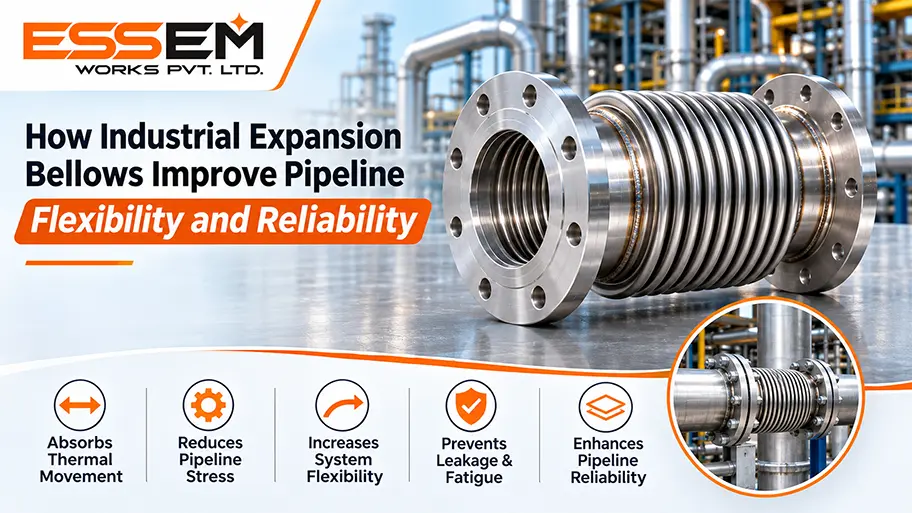
All industrial pipes experience changes in temperature, pressure, vibrations of machines, and movements of equipment. Such factors add extra stress to rigid pipes and can influence the neighboring equipment, pipe joints, and supports. In case movement is not controlled, you will receive leakage, material fatigue, and additional expenses for maintenance. Industrial expansion joints compensate such movement while preserving integrity of the pipe.
Industrial expansion bellows are flexible devices, which absorb thermal expansion and contraction, all kinds of movement of the pipe system. Besides, industrial expansion bellows reduce stresses in the pipe system. Choosing industrial expansion bellows manufacturer is significant. Essem Works manufactures different configurations of metal industrial expansion bellows and joints depending on the amount of movement and operating pressure.
Understanding the role of industrial expansion bellows
Metal industrial expansion bellows are flexible elements that can be extended and contracted in a controlled manner. Such flexible elements are used in places where compensation of movement is needed without stressing the whole system.
As metal gets hot and cold, it contracts and expands. If this fact is not taken into account, pipe supports, anchors, flanges, and nozzles of adjacent equipment will experience additional load from thermal expansion and contraction. Bellows expansion joints provide the possibility to regulate flexibility of pipe.
Increasing Flexibility of Pipeline with Expansion Bellows
Expansion joints are a crucial part of industrial systems that work under variable temperatures and mechanical conditions. There are different types of bellows joints depending on configuration and type of movement.
- Axial motion – the possibility of contraction and extension of the bellows along the pipe.
- Lateral motion – compensation of shifting of the pipe.
- Angular motion – compensation of tilting and bending of the pipe.
- Combined motion – compensation of movement in different directions simultaneously.
Reduction of stress on the pipeline and machinery
The primary function of the expansion bellows is reducing the mechanical stress as a result of the movement. If the thermal expansion of the pipeline is restricted, it causes forces, affecting pipe supports, anchors, flanges, pumps and other equipment. A correctly selected expansion joint can absorb such movement and transfer all forces within the piping system. It is vital in such systems as:
- Steam distribution, boilers connections
- Heat exchangers and condenser pipes
- Pumps and compressors connections
- Chemical and petrochemical plants
- Power plants and refineries.
It is crucial to install and arrange supports correctly.
Selection of the right bellows configuration
According to the type of movement, temperature and pressure, place of movement, there are several types of the bellows joints such as:
- Axial Expansion Joint – for axial motion
- Universal Expansion Joint – for increased lateral motion
- Hinged Expansion Joint – allows to make bends with the use of the hinge to restrict thrust
- Gimbal Expansion Joint – allows to make bends in two directions
- Pressure Balanced Expansion Joint – designed for compensation and reduction of thrust from the pressure
An experienced industrial expansion bellows manufacturer should analyze your conditions and provide recommendations on a proper configuration.
Materials Selection and Manufacturing Quality
It is an essential stage as the choice defines service life and performance. It depends on temperature and pressure requirements, corrosion resistance and characteristics of medium.
The bellows are produced from different types of stainless steels, for example, SS304L, SS316L, SS321 and alloys such as Alloy 625 and 825. Other factors in choosing an expansion joint are manufacturing quality control, welding technologies, dimensional tolerance and inspection. The design rules for expansion joints are given in the EJMA standard and EN 14917 standard.
The importance of engineering and testing
The expansion joint is not chosen only depending on the pipe diameter. We should take into account pressure, temperature, motion, fatigue life and spring rate. Before the production, the supplier should be aware of the place of installation and produce the technical drawing accordingly. Proper engineering calculation will allow us to assess mobility, stability, force action from the pressure.
Essem Works produces plenty of metal bellows and expansion joints in eight configurations ranging from DN50 to DN3000. The range of Essem Works' metal bellows and expansion joints is designed according to EJMA 11th Edition and EN 14917:2021 standards. The engineering data as fatigue life, squirm stability and spring rate are provided with every order.
Conclusion
Industrial expansion bellows are applied for increasing flexibility of pipelines, compensating thermal and mechanical movements. It helps to manage stress on connected equipment and prevents problems caused by fatigue.
The selection of a trusted industrial expansion bellows manufacturer is dependent on factors such as materials, motion, pressure, and many more engineering calculations. Essem Works provides engineered metal bellows and expansion joints for industries that require tailor-made components.