
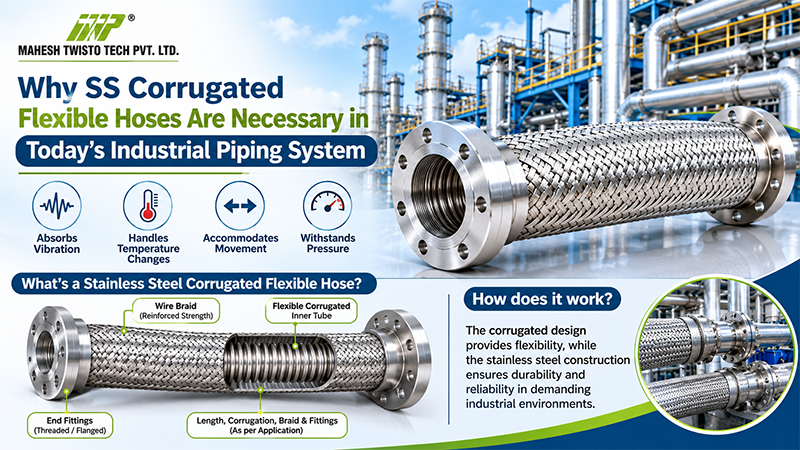
Vibration, heat expansion, and movement of equipment and pressure changes are common problems that can affect an industrial piping system. Stainless steel corrugated flexible hoses are often chosen for industrial application because of its flexibility and ensures that the piping is firmly connected.
There’re several things that must be considered when selecting the proper hose; like pressure, temperature, media, movement, end fitting, and conditions.
Essem Works Pvt.Ltd, well renowned SS Corrugated Flexible Hose manufacturer. We aim to understand how the hose assembly will operate within its environment and what engineering requirements are needed.
What’s a Stainless Steel Corrugated Flexible Hose?
Stainless Steel Corrugated Flexible Hose is a flexible metal tube that has ridges and grooves (corrugations) at regular intervals. This enables flexibility.
If extra pressure resistance is required for an application, a wire braid can be added. This’ll help to reduce expansion caused by pressure.
Depending on the application, there are a range of stainless steels, braid options, lengths and end fittings.
How does it work?
The flexible hose is made using a corrugated design.
The components include:
- Flexible Corrugated Inner Tube – Flexible stainless steel tube.
- Wire Braid – Reinforced stainless steel braid.
- End Fittings – Threaded, flanged, welded or other. These enable the hose to fit into the pipework.
- Length, Corrugation, Braid & Fittings – Selected to suit the operating conditions.
A correctly selected hose assembly will help to absorb vibrations, movement from connections and some thermal movements. The hose should be installed within the recommended bend radius and movement.
Types
Depending on the application there are a range of hose assemblies available:
1. Unbraided Corrugated Hose
This is a flexible stainless steel hose that doesn’t have a wire braid surrounding the hose. This can be suitable for low pressure applications or vacuum applications.
2. Single Braided Corrugated Hose
This hose has one wire braid. These are commonly used for industrial applications where flexibility, pressure resistance and isolation from vibrations are a must have.
3. Double Braided Corrugated Hose
This hose has two braids. This can help increase the pressure resistance, depending on the hose diameter, material, temperature and design.
4. Custom Corrugated Hose Assembly
Some installations may require a certain length, fittings, materials and connections. Custom assemblies can be manufactured to suit customer drawings and requirements.
We manufacture braided corrugated stainless steel hose assemblies ranging from DN6 to DN350. We can supply 304L, 316L and 321 materials. Different end fittings can be supplied.
Uses
Corrugated flexible hoses are used across many industries.
Common uses include:
- Chemical & Petrochemical – Compatible chemical and process lines.
- Oil & Gas – Suitable process connections, equipment connections and loading.
- Power Generation – Steam connections and equipment, if hose design is suitable.
- Pharmaceutical – Compatible process lines, utilities and certain material and surface finish requirements.
- Food & Beverage – Suitable liquid transfers, if assembly meets the hygiene and cleaning conditions.
- HVAC & Mechanical – Connections that require vibration isolation.
- Automotive & Engineering – Suitable fluid, gas and equipment connections.
How to Choose the Correct Corrugated Flexible Hose
It’s important to understand the technical requirements for your application. As an SS Corrugated Flexible Hose Manufacturer we recommend taking the below into consideration when choosing your product.
1. Material
Depending on the media, temperature and corrosion, a specific grade of stainless steel will be required.
Common options include:
- SS 304L – Used in many general industrial applications.
- SS 316L – Considered for better resistance to certain corrosive environments.
- SS 321 – Used in certain applications where high temperature properties are beneficial.
Always select a material after considering the process conditions.
2. Pressure
Ensure you know what the normal working pressure, maximum pressure and pressure surges are. The hose and end fittings should be suitable for the application.
The braid design, diameter, temperature and design will effect the working pressure.
3. Temperature
The temperature can affect the mechanical properties and pressure of the stainless steel. Make sure the hose assembly is well suited for the both the minimum and maximum temperature.
4. Diameter
The diameter should be suitable for the flow rate required. This’ll help to avoid excessive pressure loss and vibrations. The length should also be suitable for the movement required.
5. Bend Radius & Movement
Flexible hoses have a minimum bend radius and movement. Avoid sharp bends, excessive movement and twisting as this can cause the hose to have a reduced service life.
6. End Fittings
The end fittings will need to suit the equipment and pipework. Options include:
- Threaded.
- Flanged.
- Butt Weld & Socket Weld.
- Hygienic.
- Hydraulic & Quick Release.
Inspection & Testing Requirements
Ask what inspection and testing is required. If it’s a pressure assembly then hydrostatic testing can be carried out and relevant documentation will be provided to ensure the product meets the requirements.
Why Choose Essem Works Pvt.Ltd?
At Essem Works Pvt. Ltd we manufacture stainless steel corrugated flexible hose assemblies, interlock hoses and metal bellows expansion joints.
We understand that flexible hoses are not just for joining pieces of pipework together. The design and specification will have a direct impact on the reliability of the pipework. We aim to understand the requirements of the application, technical requirements and design a suitable assembly.
Options available:
- 304L, 316L & 321 materials.
- Single & Double Braided.
- DN6 to DN350.
Different end fittings. We can manufacture to customer drawings.
All corrugating, braiding, welding and testing is carried out in house.
All pressure assemblies will be hydrostatically tested prior to dispatch. Test certificate will be supplied.
We’ll work with customers to understand what medium, pressure, temperature, movement and connection requirements are required.
Conclusion
In selecting the right stainless steel corrugated flexible hoses, you’ve to consider factors like: grade of material, pressure, temperature, flexibility, braid, and fittings. In selecting the right hose assembly, one can achieve vibration dampening.
When choosing an SS Corrugated Flexible Hose Manufacturer, look beyond the price of the product. Ensure they can help with engineering, manufacturing, testing and manufacturing to your requirements.
At Essem Works Pvt. Ltd we manufacture stainless steel braided corrugated hose assemblies. We aim to design a hose assembly to suit the application and carry out quality testing. If you have any technical requirements or drawings, please get in touch so that we can help identify a suitable hose assembly for you.
FAQ
1. Which types of stainless steel are employed?
The common types are SS 304L, SS 316L and SS 321. The type of stainless steel that’s required depends on the media, temperature and corrosion.
2. Can they be customised?
Yes. They can be specified to have different lengths, diameters, braiding and end fittings. This should be based on the technical requirements of the application and approved drawings.
3. How do I choose the correct length?
Consider how far apart the connections are, how much movement is required, layout and minimum bend radius. Don’t stretch, compress or twist beyond the limits.
4. Do you manufacture stainless steel corrugated flexible hoses?
Yes. We can manufacture stainless steel braided corrugated hoses ranging from DN6 to DN350. We can supply 304L, 316L and 321 materials. We can supply different braiding and end fittings dependant on the application.