
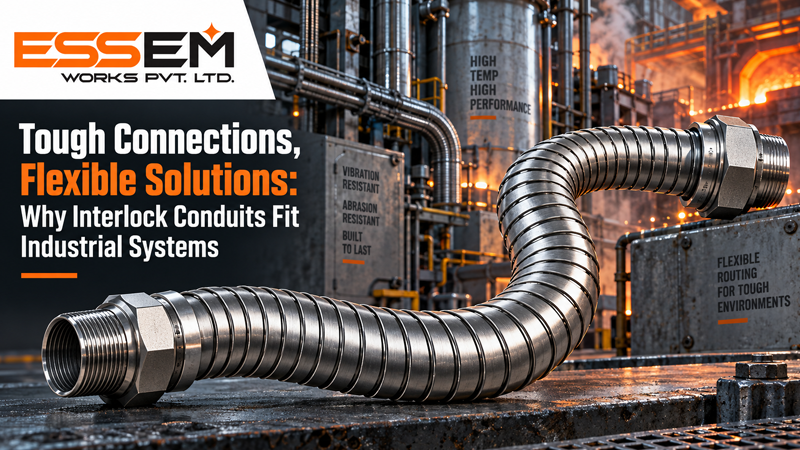
Industrial systems rarely operate in perfectly straight lines. Equipment moves, machinery vibrates, temperatures rise, and components often need protection in demanding environments. In such conditions, rigid connections can become a weak point. This is where interlock conduits offer a practical combination of flexibility, mechanical protection, and durability.
Interlock conduits are formed through the helical winding and mechanical interlocking of a profiled metal strip. This interlocking feature enables the components to have relative motion between themselves, thus rendering flexibility to the conduit. In cases where the industry is faced with high temperatures, wear, vibrations, and difficult routing requirements, the importance of such a design cannot be overemphasized.
What Makes Interlock Conduits Different?
Unlike a conventional rigid tube, an interlock conduit can bend and accommodate movement without losing its basic shape. Its flexibility comes from the sliding action between the interlocked coils rather than from stretching the metal itself.
This construction also helps absorb vibration. Instead of transferring every movement directly to connected equipment, the friction between the coils can dissipate some of the mechanical energy. This makes interlock designs useful around engines, generators, exhaust systems, machinery, and other equipment where continuous vibration is expected.
For industrial applications, this flexibility is more than a convenience. It can simplify routing, reduce mechanical stress, and make connections easier to accommodate when equipment layouts change.
Built for Heat, Abrasion and Mechanical Protection
There are many ways that an industrial setting can subject hoses, cables, and flexible joints to conditions that normal materials will not be able to cope with. This includes heat, physical impact, abrasion, and dust.
Stainless steel interlock conduit (such as an SS interlock strip-wound hose) provides a robust outer structure for such environments. Depending on the material and design, interlock hose can handle demanding temperature conditions.
Where Do Interlock Conduits Fit Best?
The right application depends on the operating conditions, but several industrial systems can benefit from their construction:
- Machinery and Equipment: Moving machines need flexible joints that allow for vibration and limited routing. Interlock construction provides the flexibility needed around equipment while adding mechanical protection.
- Exhaust and High-Temperature Systems: Generators, engines, furnaces, and other equipment produce significant heat. Interlock products are commonly used for flexible exhaust and ventilation connections where heat resistance and movement are important.
- Abrasive Material Handling: In bulk material handling, fast-moving particles can wear conventional hose structures. Heavy-strip interlock designs are useful in applications involving abrasive solids, dust extraction, and conveying systems.
- Cable and Component Protection: Interlock conduits act as protective armour around cables or flexible components operating in harsh areas. Their mechanical strength and flexibility make them ideal where routing changes or physical exposure are concerns.
Choosing the Right Construction Matters
Not every flexible connection is suitable for every industrial duty. One of the most important considerations is pressure. A plain interlock hose is generally not pressure-tight because its construction relies on a mechanical seam rather than a continuous pressure boundary. For pressurised applications, a braided corrugated hose may be the more appropriate choice.
Temperature, bore size, movement, abrasion, material compatibility, and end connections are factors that must be considered before choosing a product.
As a stainless steel interlock conduit manufacturer, Essem Works Pvt. Ltd. focuses on engineering the product around the actual requirements of the application rather than treating every installation the same. Its interlock range includes different construction options and stainless steel grades for varied industrial requirements.
Why Specification Should Come Before Selection
A stainless steel interlock conduit may look simple, but its performance depends heavily on correct specification. Engineers need to consider factors like the medium, pressure, temperature, motion, installation and connections before coming up with an assembly.
It will assist in avoiding challenges like excessive bending, wrong pressure application, premature wear and improper installation. Essem Works recommends sharing key operating details so the appropriate assembly can be specified for the application.
Conclusion
Interlock conduits prove that industrial connections do not have to choose between strength and flexibility. Their mechanically interlocked construction provides movement, vibration damping, heat resistance, and mechanical protection where conventional rigid connections may fall short in fluid and gas piping systems.
For demanding systems, however, performance depends on choosing the right construction for the actual duty. With suitable material, size, configuration, and installation, stainless steel interlock conduit can become a dependable part of industrial equipment and process systems when specified with an experienced manufacturer at Essem Works.