
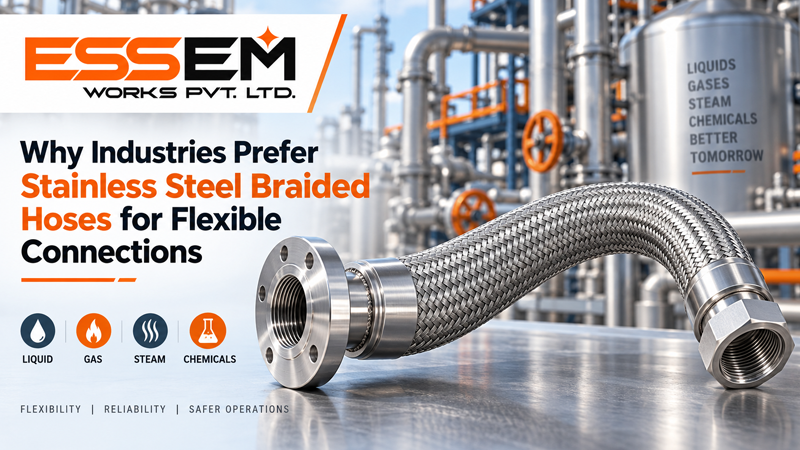
Liquid, gas, steam, chemicals and other substances are commonly used in industrial processes. Even though piping is rigid, it is not flexible enough to allow for vibrations, movements, heat expansion or displacement of machinery. This is where flexible hoses become an important part of the system.
A well-designed hose must match the application in terms of pressure, temperature, media compatibility, connection type, and operating conditions. Essem Works Pvt. Ltd. is the best stainless steel braided hose manufacturer, offering solutions customized according to industrial needs. The proper design of the hose ensures its reliability in various industries.
What Makes Stainless Steel Braided Hoses Different?
The construction of this hose usually involves an inner flexible hose enclosed by one or several layers of braided stainless steel wires. The inner hose transfers the gas or liquid, whereas the braided part gives extra mechanical strength to the structure.
This construction allows the hose to bend while helping it withstand pressure and external stresses. Depending on the design and application, hoses can be manufactured using suitable stainless steel grades, tube materials, braid configurations, and end connections.
The combination of flexibility and reinforcement makes these hoses particularly useful where conventional rigid piping may not be practical.
Key Features & Advantages
1. Excellent Resistance to Pressure
Industrial connections can be exposed to considerable internal pressure. A hose without sufficient reinforcement may expand, deform, or fail under demanding conditions.
Stainless steel braid controls the expansion of the inner tube and increases the pressure resistance of the hose. For this reason, braided hoses are appropriate for use in situations involving pressure changes or high operating pressure.
However, the correct pressure rating should always be selected according to the actual operating conditions rather than relying only on the appearance or size of the hose.
2. Handles Vibration and Equipment Movement
Machinery rarely operates without vibration. Pumps, compressors, engines, production equipment, and other moving systems can transfer vibration into connected piping.
The problem of excessive stress may arise in the case of rigid connection in conditions of constant motion. Flexible hoses (such as SS braided corrugated hoses) can withstand a certain level of vibration and motion.
This is one of the reasons why flexible joints are so useful where equipment is located since there might be wear and tear associated with a completely rigid joint.
3. Performs Well Across Temperature Changes
Industrial processes may involve significant temperature variations. Heating and cooling can cause pipes and connected equipment to expand and contract.
These hoses can offer flexibility, thus helping with the thermal movements in the system (much like expansion joints and metal bellows). Therefore, they are useful in handling hot liquids, steam, gases, and other temperature-related processes.
The hose material, construction, and end fittings still need to be selected according to the actual temperature range of the application.
4. Flexible Installation in Confined Areas
The route for industrial installations is not always a straight line. Machines can be placed near each other, but pipes need to be routed around other machines or structures.
Flexible hoses can simplify such connections by allowing controlled bending and movement. This can make installation more convenient and reduce the need for complex rigid piping arrangements.
However, hoses should never be bent beyond their recommended limits or forced into unsuitable installation positions.
5. Suitable for a Wide Range of Industries
They can be used across diverse industrial applications. Depending on their construction, they may be found in chemical processing, pharmaceutical equipment, food processing, petrochemical systems, engineering machinery, gas systems, hydraulic applications, and other industrial setups.
The versatility of these tubes is based on their capacity to vary the materials used in the inner tubes, braid constructions, length, and end terminations.
Choosing the Right Stainless Steel Braided Hose
The performance of a flexible hose depends on more than just its material. Before selecting a product, industries should consider:
- Operating pressure and pressure fluctuations
- Minimum and maximum operating temperature
- Type of fluid or gas being conveyed
- Required hose length and bend radius
- Frequency of movement or vibration
- Stainless steel grade
- End connection and fitting requirements
- Installation environment
- Applicable industry or safety requirements
Why Quality Matters in Industrial Flexible Connections
A flexible hose may be a minor component in a big industrial setup, its performance is essential to determine reliability and safety in fluid and gas piping systems. The use of substandard material, inappropriate fittings, wrong dimensions, or faulty assembling will result in leakage and early breakdowns.
Essem Works Pvt. Ltd. is the leading stainless steel braided hose manufacturer, focusing on providing stainless steel flexible hose solutions designed for industrial requirements. By considering hose construction, reinforcement, connection requirements, and application conditions, contacting our engineering team at Essem Works helps ensure the right product supports dependable and efficient flexible connections.